



hile visitors come to Watches and Wonders expecting to see unorthodox movements, eye-catching designs, superb craftsmanship, novel functions or new angles on traditional complications, it’s rare to discover anything truly surprising in gem-set watches. Not so this year. Two models in particular have rewritten the rules of gem-setting. Both are by Hublot, a brand at the forefront of materials research. Granted, diamond isn’t a “new” material, having formed hundreds of millions of years ago at Earth’s core. What is completely unprecedented is its treatment by the Manufacture, which is based in Nyon, Switzerland.
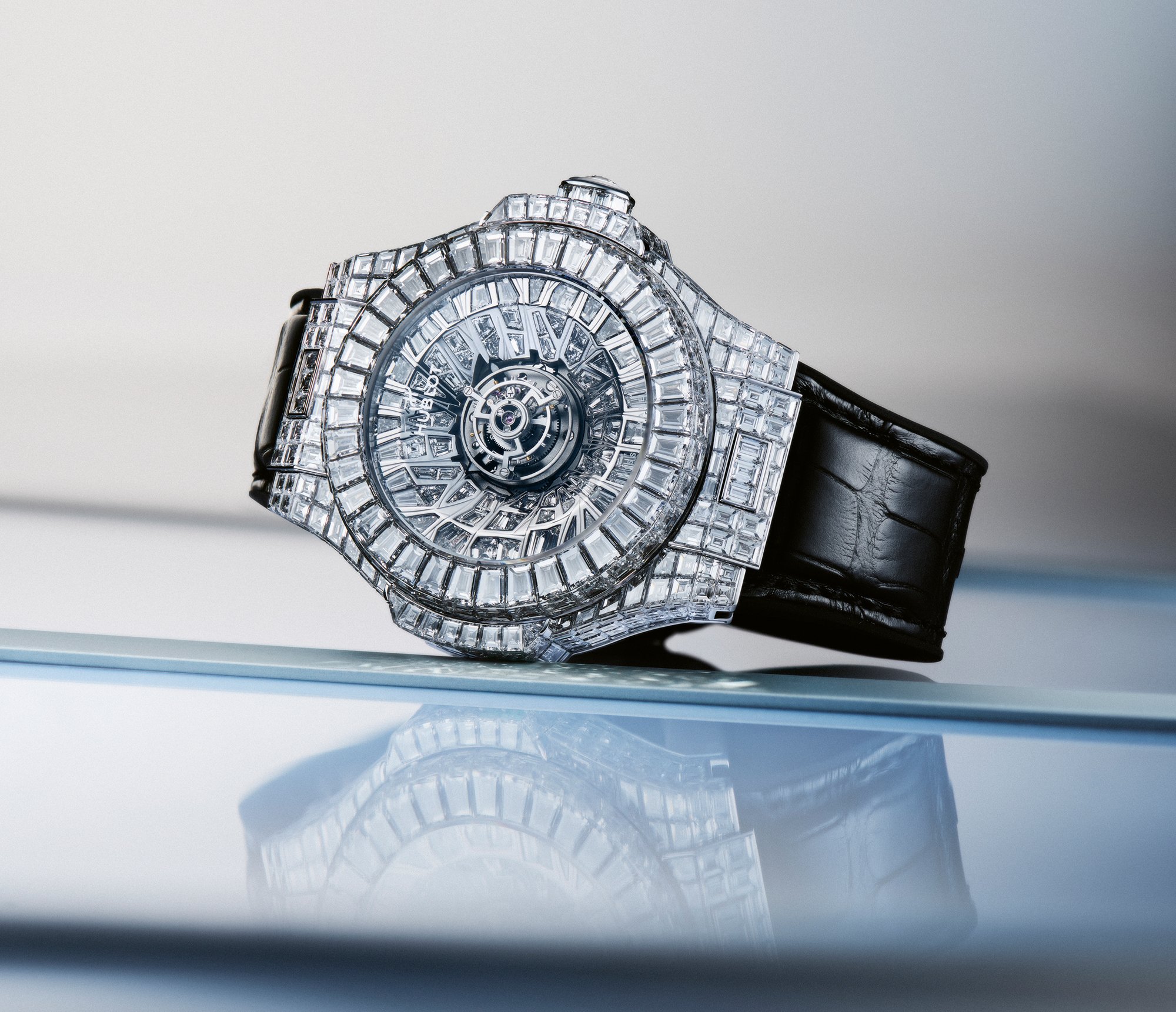
The Big Bang Impact One Million is swathed in custom-cut diamonds, while the Spirit of Big Bang Impact Sapphire Jewellery sets diamonds in a sapphire case, using an undisclosed technique. So as to give the illusion of a diamond exploding under the force of an impact, its shards embedding themselves in the sapphire, Hublot Chief Executive Julien Tornare turned to one of Switzerland’s foremost gem-setters, the expertise of the leading diamantaires and the Manufacture’s own R&D division.
The result is spectacular to say the least, all the more so considering the complex process of bringing these two watches to life. First, the rough stones are cut, following an exact design, into precisely calibrated forms to create the impression of a dial made from shards of shattered mirror. Unique in shape and size, each stone is then set in the sapphire case, using a specially developed technique. The finished effect brings Indian inlay to mind but the method is entirely different, says Julien Tornare, who is giving nothing away.

Europa Star Jewellery: We’re here to talk about these two extraordinary watches but first, we can’t not mention the new Manufacture. It’s gigantic!
Julien Tornare: I came back to my office yesterday after a nine-day trip and yes, the working environment is quite spectacular. We have a vast atrium and a sports field that you can see as you come in to land at Cointrin airport. I actually took a photo from the plane showing the H for Hublot marked out on the ground. It’s like a heliport. This space is intended first and foremost for our staff but we can also use it to host events with our ambassadors from the world of sport. And this is only the beginning! We’ve put together a visitor journey like nothing else in the watch industry.
What kind of visitor journey? An experience similar to the one you devised at Zenith?
No, nothing like that. At Zenith, we focused on the famous attic which, during the 1970s, served to hide the tools used to manufacture the El Primero movement. The emphasis was on the Manufacture’s history and legacy. At Hublot, the visitor journey will be huge: a mix of technology, experimentations, an art gallery and other things that don’t exist at any other Manufacture. Customers, the media, fans of Hublot, anyone who comes to the Manufacture will be completely immersed in the brand universe. We want the Manufacture to be outward-facing, somewhere people will come and spend time. There’ll be a space where we can organise events for customers, such as a birthday party, anniversary celebration, vow renewal, whatever they ask for. Hublot is about emotions and we want our customers to experience memorable moments here.
You showed a number of gem-set models at Watches and Wonders, including the Spirit of Big Bang Impact Sapphire Jewellery and the Big Bang Impact One Million, both with a “shattered” motif. How important are gem-set watches for Hublot?
Since arriving as CEO, I’ve worked on elevating the brand. First of all, I want Hublot to be given credit for its expertise in watchmaking. As a brand, Hublot has often been singled out as the most dynamic in terms of marketing and for its groundbreaking innovations in materials. We probably haven’t said enough about our capabilities as watchmakers when we’re actually on the way to producing 100% of our movements. Our gem-setting competencies are part of this evolution. Hublot has already demonstrated its taste for incredible gem-set watches, not least the Big Bang One Million in 2010 and the Big Bang 5 Million in 2012. The question for Watches and Wonders 2026 was how could we be even more innovative with diamonds? Gem-setting, at this level of precision, is one of the specialisations we want to highlight, including with a new diamond cut.
Will you be doing this high-precision setting within the Manufacture?
We have our own gem-setters at the Manufacture, but for exceptional pieces that require specific expertise we’ll continue to work with a leading partner in Geneva. They have been working with Hublot for some considerable time and share our vision for the brand. They do much more than execute an order. They take an active part in the design process for the gem-set models and are involved in the project from the early stages.
The diamonds on the Spirit of Big Bang Impact Sapphire Jewellery are set directly in the sapphire case. We know that sapphire is incredibly difficult to work with. It ranks 9 on the Mohs scale of hardness, just below diamond at 10, which makes machining the mounts for the diamonds an impressive feat. How did you manage this?
After extensive research. We came up against some challenging moments, times when we weren’t even sure we would reach our goal. Although we do partly master the technique in-house, we needed the support of an external company to develop an entirely new procedure. We’ve agreed not to give too much away as we are the only ones to master this technique and we prefer to keep it secret.
Is it similar to the inlay technique that originated in India, where stones are inlaid into a carved base?
I know the technique you’re referring to but the one we developed is different. It’s an entirely innovative approach that produces this exceptional result. Aesthetically speaking, it’s one of the most beautiful pieces I’ve ever seen.
You describe the Big Bang Impact One Million as the fusion of haute horlogerie and high jewellery. Where do you put the cursor?
Primarily on haute horlogerie, with jewellery grafting itself onto Hublot’s watchmaking. The R&D division is currently working on new movements and case materials, and gem-setting forms part of this. We tried to imagine how a diamond would be transformed, aesthetically speaking, by the impact from the Big Bang. The end result could only be achieved using bespoke diamond cuts. Going forward, the traditional diamond-set bezel will feature less and less in our offering. Hublot has been so incredibly innovative in developing new materials that we have to be equally innovative with our jewellery watches. Expect some surprising reveals in the years to come. Hublot is a watchmaker that knows how to make jewellery watches, but isn’t a jeweller.

The way the diamonds are set resembles a shattered mirror.
That’s exactly the effect we were aiming for. The brief was to imagine a diamond that had exploded after a powerful impact. What would it look like? The result has drawn a hugely positive response. We’re in the process of delivering the first pieces. They’ve taken a while to produce, because of the complexity, but it’s a model that’s really resonated with people.
This is a gem-set watch but it’s also a high-mech piece with a central flying tourbillon.
That’s right: the fusion of both disciplines. We have to be able to work across the two. We’ve associated haute horlogerie with innovative materials on numerous occasions. Just a couple of days ago I was in New York, having a conversation with one of our customers who was buying a Spirit of Big Bang Impact Sapphire Jewellery. We discussed the difficulty of creating a sapphire case fitted with a magnificent tourbillon. I explained how we produce this complication entirely in-house. We are the only brand growing sapphire blocks in our research and development division, helmed by Mathias Buttet. The same is true of our ceramics. The Big Bang Summer I’m wearing today makes a powerful statement about our expertise in coloured ceramics. Think back to the All-Black in 2006 and you realise that many others have followed Hublot’s lead and moved into the space that we opened up. We have to stay out in front.
On that note, are you currently working on new materials?
Yes, we’ll be presenting new materials before the end of the year, including one that we’ll use to launch the softest watch ever. A watch is something you wear the entire day, so it has to be comfortable, but the relationship I have with my watch begins when I pick it up from the bedside table, or take it out of its box, and put it on my wrist. Some watches feel pleasant to the touch — the case, the strap, the buckle —, others less so. This autumn we’ll release a watch that feels as soft as silk, with more materials coming out next year. We’ve been criticised in the past for using outsourced movements and I’m in the process of resolving that. However, no-one can challenge our lead in materials research.

Coming back to diamonds, were the stones for these models cut to precise specifications?
Yes, each stone had to be cut to the exact shape we required. No two are the same. We wanted the end result to resemble shards of glass but not something random. It had to be aesthetically pleasing and it had to be immediately obvious that it was the result of an impact. We supplied rough stones which the diamantaires cut to our specifications. It’s a complicated process.
Are the diamonds always set in the same pattern?
Absolutely. All the settings are to the same design and the diamonds are cut on the basis of that design.
And was this design dictated by the movement of the Big Bang Impact One Million, with its central flying tourbillon?
Yes. Our intention was that the dial should focus attention on the movement and all its features. The diamonds shouldn’t compete with the tourbillon but bring out its beauty even more. The movement becomes the key element for us.
For years, jewellery watches have used precious stones to decorate a bezel, case or dial, whereas the Big Bang Impact One Million and the Spirit of Big Bang Impact Sapphire Jewellery seem more intent on proving that diamond can become an actual material in watchmaking, on a par with carbon, sapphire and ceramic.
That’s right, we should be treating these stones in the same way. In the past we’ve used coloured diamonds and new cuts, and we can go further in our explorations. We reinterpreted gold with Magic Gold and now we have ideas about how we can do the same with diamond that would go beyond the four Cs of cut, colour, clarity and carat. Diamond is an area ripe for exploration, like any other, and one of the three top priorities of our research and development division.
Can we consider Hublot high jewellery watches as a creative laboratory?
Definitely! A laboratory where major innovations will take shape. We’ll go on making watches with gem-set bezels. They’ll be our day-to-day. As for our exceptional pieces, we’ll be doing some very special research.
Will we one day see a case cut from a rough diamond?
I think so, yes. It hasn’t been done yet, not that I know of, but Hublot would have complete credibility in launching such a watch. It would come at a price but it would be spectacular! In four years we’ll be celebrating the brand’s fiftieth anniversary. We could imagine some really remarkable things in diamond for the occasion. We made a watch case from a single block of sapphire. I’m sure we’re capable of doing the same thing in diamond.


