



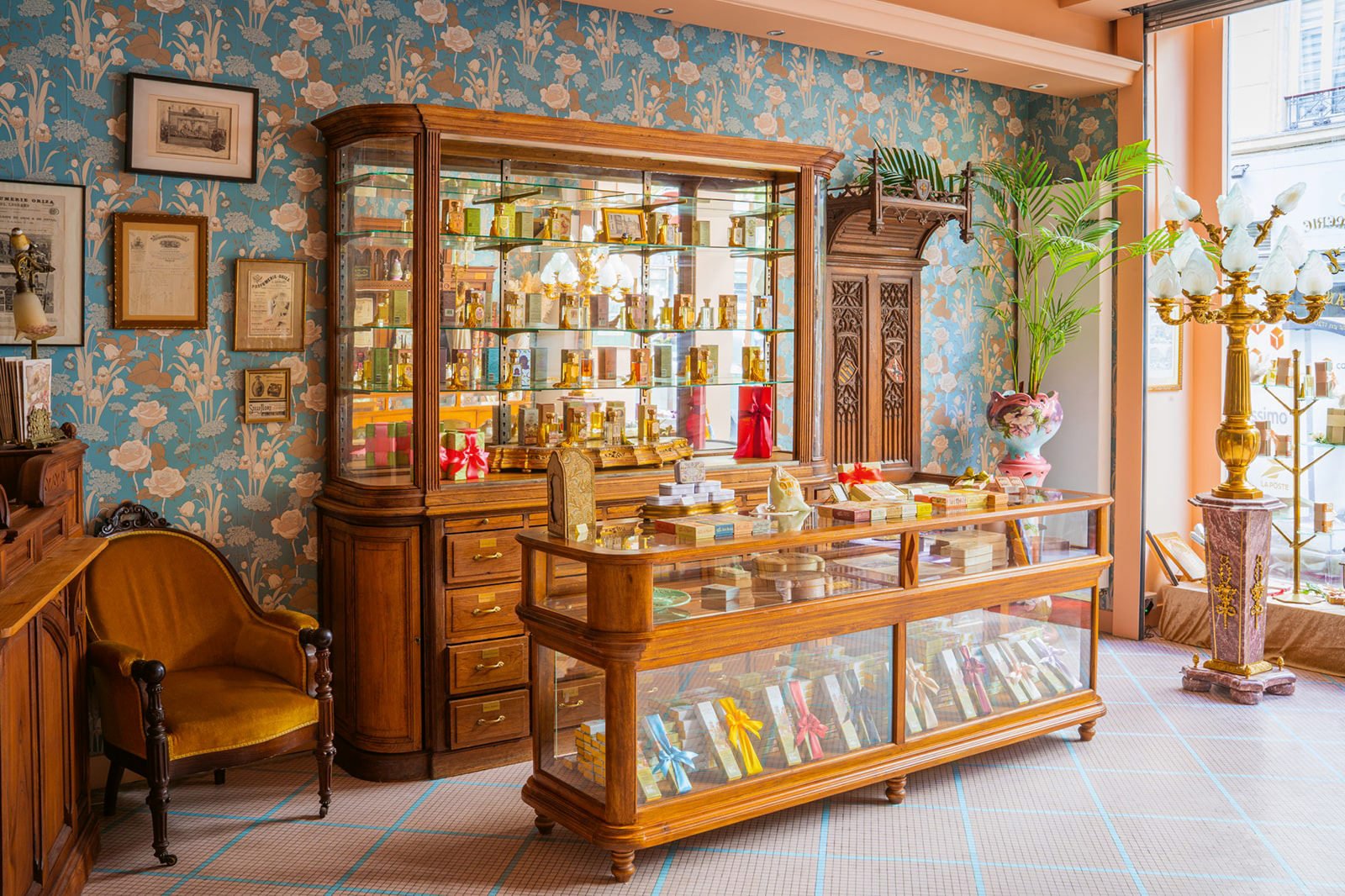
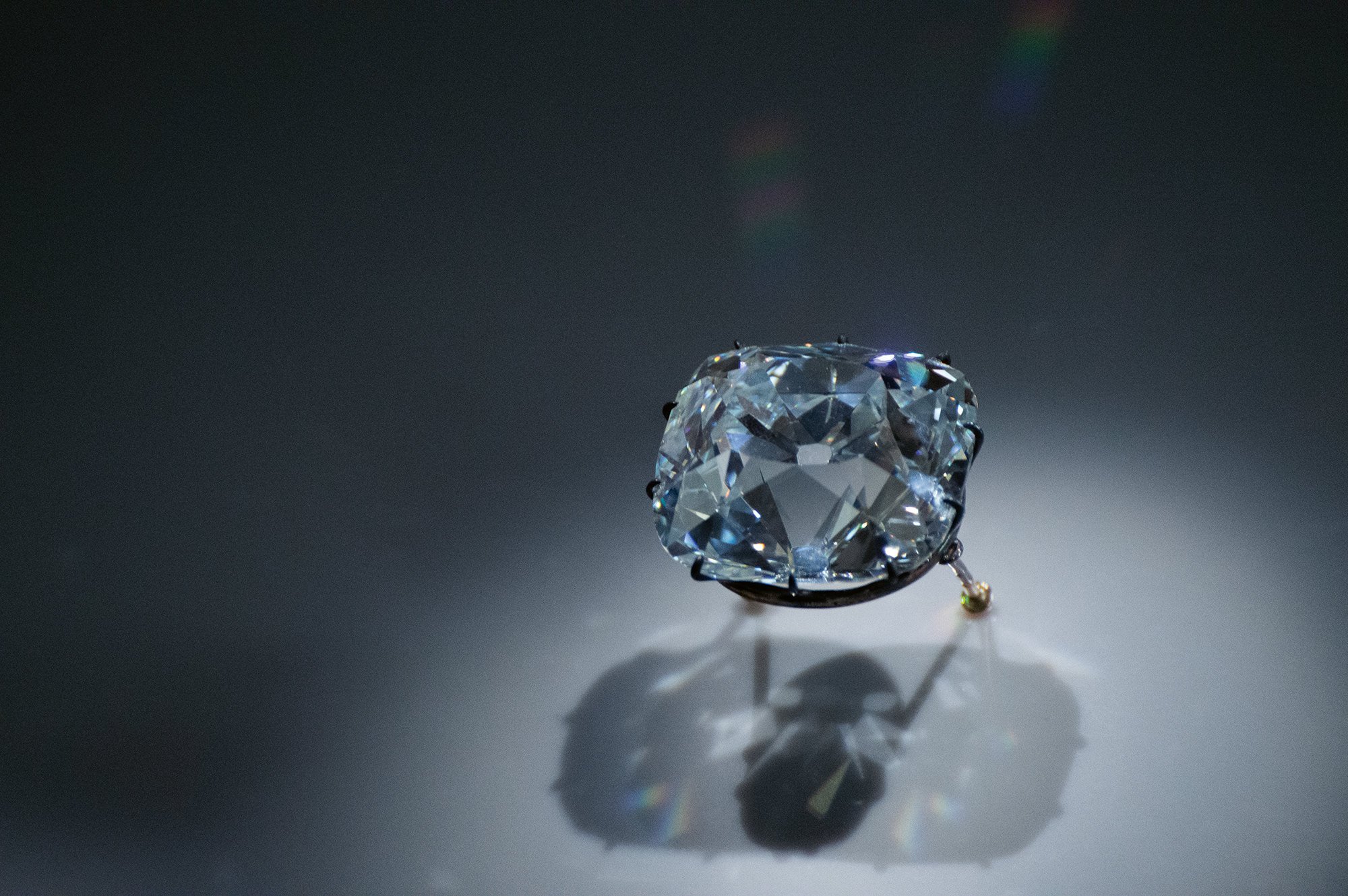
omposed, it is said, from ambergris, vanilla, leather and benzoin, Le Régent encapsulated the splendour and opulence of an era. An Oriental fragrance, it was created by Parfumerie Oriza de Fargeon-Aîné, perfumer at the Court of King Louis XV who in 1720 had the privilege of opening a boutique within the Louvre’s Cour Carrée. This was a fragrance almost as dazzling as the eponymous jewel that inspired its creation: a 140.5-carat cushion-cut diamond of the first water—the largest diamond in the French Crown Jewels.
The inventor of this fragrance, the perfumer Fargeon l’Aîné (“the Elder”), had been making eaux de toilette and scented soaps since the turn of the eighteenth century. He dedicated this Oriental fragrance, with its balsamic accord and its base note of storax that lingers on the skin, to the Regent Diamond, considered by many as the “star” of France’s Crown Jewels.
A forgotten formula
The perfume is a delightful amber jus while the “other” Regent has the purity of water. Its notes are that of an Oriental fragrance while its homonym was discovered in India at the end of the seventeenth century. The diamond takes its name from the Regent, Philippe II, Duke of Orleans, one of the first to acquire the stone, and was worn by Louis XVI and by Marie-Antoinette. Napoleon had it set into the guard of the sword he carried for his coronation. As for the perfume, it was dabbed onto wrists and throats, sprinkled on handkerchiefs (some more delicate than others) and lavallieres. Alas, its formula was forgotten until an intrepid and passionate entrepreneur, Hugo Lambert, revived the Oriza L. Legrand perfume house in 2012 (omitting the name of Fargeon l’Aîné) and recreated Le Régent in 2020.

“Some substances travel through time with greater consistency than others,” says Lambert with a smile. “Finding Le Régent’s archives took time and patience. Historical formulas are rarely as precise as our modern-day standards require. Proportions were sometimes implicit; ingredients were known by names that have since disappeared. We had to cross-reference sources, place ingredients within their historical context and recapture the intent rather than follow the formula to the letter. Some ingredients no longer exist while others have evolved. We can, on the other hand, recreate a structure, an equilibrium, an olfactive logic. This is a respectful interpretation, comparable to musicians performing an ancient score: the spirit remains, even if the instruments have changed.”
140 carats and nearly flawless
At the time of the perfume’s creation, the Crown Jewels were a symbol of splendour and authority. Aja Raden, a historian of precious stones and jewellery, and the author of Stoned, the first volume in a series of books on stones that shaped the world, describes the Regent’s historical context: “By the time of Louis XV, the Regent had already achieved near-mythic status, because of its perfection. At roughly 140 carats, nearly flawless and pale blue-white in tone, it was widely regarded as one of the finest diamonds in Europe—almost a “first among equals”. It was also considered a technical marvel. The eighteenth century was becoming increasingly fascinated with optics and light, and the Regent’s cut was praised as harmonious, ideally proportioned and extraordinarily brilliant. It was more than a gem; it was an emblem of the Bourbon monarchy itself—wealth, spectacle, refinement and unapologetic opulence. If this was the stone representing the dynasty, then it encapsulated everything that dynasty wished to project. Writers and jewellers described it as flawless, balanced and near-perfect, and the idea of perfect beauty was profoundly important in eighteenth-century France. Beauty was not merely decorative; it was ideological. Spectacle, symbolism, wealth, power and aesthetics were tightly interwoven concepts, and the Regent distilled all of them into a single object. It was the ultimate talisman of Bourbon monarchical authority.”
Fargeon l’Aîné created “his” Le Régent in honour of this remarkable stone, as a representation of beauty, power, opulence and luxury, hence its Oriental allure, its balsamic head notes and a heart of precious ambergris merging with vanilla—an ingredient so desirable, noble and addictive that it was, then as now, wildly expensive.
“The royal court under Louis XV was known as ‘the perfumed court’ and for good reason,” Hugo Lambert continues. “Perfume was omnipresent and used every day. People didn’t just apply perfume to their skin. They drenched themselves in it. Even certain items of furniture were doused in fragrance. Each day could call for a different perfume. In a world without modern hygiene, perfume became a protection, an adornment and a signature. It enveloped the court in a permanent, almost theatrical, aura. Fargeon l’Aîné had a boutique in the Louvre’s Cour Carrée under Louis XV, which put him literally at the heart of power. Merchants who did business at the Louvre belonged to a privileged circle, as close to the court and the elite as it was possible to be.

He wasn’t on the edges of power—he moved within the immediate environment of royal authority, among artists, merchants and the king’s officers. Fragrances of that time favoured animal ingredients and resins. Oriental fragrances dominated, as symbols of power and wealth, but with floral notes that introduced brightness and elegance to the whole. Their depth and longevity conveyed this notion of timeless majesty. The perfume we recreated in 2020 doesn’t seek to reproduce the diamond’s transparency but instead express its symbolic value.”
Le Régent is the first volume in “Les Joyaux de la Couronne”, a collection that will shortly pay homage to two other royal diamonds: the Sancy and the French Blue. “These three important jewels form a historic triptych,” notes Hugo Lambert. “Each is rich with symbolic value and a singular olfactive interpretation.”
THE REGENT, THE DIAMOND OF FRAGILE THRONES
Aja Raden, a New York Times Bestselling Author, historian, scientist and jewellery designer, is the author of Stoned, a social history of precious stones. She shares her perspective on the social and historical context surrounding the Regent during the reign of Louis XV, when Fargeon l’Aîné, a perfumer established in the Louvre’s Cour Carrée, created an Oriental fragrance in honour of the finest diamond in the king’s collection.

Europa Star Jewellery: In the next volume in the Stoned series, which you’re currently writing, what role do you give to the Regent, one of the most beautiful diamonds in the world and “star” of the French Crown Jewels?
Aja Raden: Well, it’s still very early and I’m not supposed to say too much, but the next book in the Stoned series focuses on nine diamonds. Each chapter centres on a single stone and its role in history. Not as a prime mover, but as a lens through which to understand power structures: how they work, how they evolve, how they fail and what replaces them. Diamonds don’t create power, but they reveal how it’s organised and how it’s believed in.
The chapter on the Regent, in particular, is about the emergence of democracy. To me, the Regent is the diamond of fragile thrones. It doesn’t represent brute force the way the Koh-i-Noor does, nor marketing mythology like the Tiffany Diamond, nor persuasive storytelling like the Hope Diamond. Instead, it embodies divine sovereignty. It’s an extraordinary lens through which to examine the tension between rulers and the ruled.
For a time, it was one of the most important diamonds in the world—intimately aligned with French and European monarchy, especially the divine justification of kingship. As long as divine monarchy was a stable system, the Regent flourished within it. But after the French Revolution and Napoleon, as democratic ideals took hold and the theory of divine right collapsed, the Regent’s meaning shifted as well.
Diamonds are constructs. They exist exactly in the way we believe they exist. For centuries, the Regent existed as the crown jewel of the Bourbon monarchy—and of divine monarchy more broadly. We need these objects to mean something. The Regent once meant absolute kingship in France.
After the Revolution, it quite literally changed position: Napoleon mounted it in his sword as a conqueror. It passed through imperial hands, but its meaning could no longer return to what it had been. Eventually, it became what it is today: not the property of a king, but a treasure belonging to the French people. It remains in the national collection because it no longer signifies divine authority. It signifies the transfer of authority. It doesn’t belong to a monarch anymore. It belongs to France.
Some say the Regent wasn’t among the jewels stolen from the Louvre because of its reputation for bringing bad luck to whoever wears it. What do you think?
I always laugh about cursed diamonds because, apparently, all diamonds are cursed. I can’t think of a single gigantic historic stone that doesn’t have at least a loosely attached curse story. And the funny thing is, most of those stories share the same hallmarks: it was stolen in a daring theft from India—usually from a temple, sometimes straight out of the eye socket of a giant Hindu idol—smuggled through the jungle, brought back to the West, then people killed, betrayed or ruined themselves over it.
These stories are so similar because they’re not really about curses. They’re an amalgamation of human psychology and the very real, often violent history of empire and extraction. Many of these stones did originate in India. Many were, if not outright stolen, at least ill-gotten. And once they arrived in Europe, people did behave irrationally. They fought over them, bankrupted themselves over them and sometimes died in pursuit of them. But that’s not metaphysics. That’s desire, greed, ambition and power.
So to answer your direct question: no, I don’t think the Regent was left behind because it’s cursed. People robbing museums are generally not concerned with bad karma. A vague legend about misfortune would not deter someone bold enough to steal the French Crown Jewels. Most large diamonds have curse stories and they get stolen anyway.
So why do you think it wasn’t part of the heist?
What’s more interesting is that the theft itself appeared highly selective. Quite a bit of priceless material was left behind. The pieces taken were closely associated with Napoleon, which suggests the thieves may have been acting on behalf of a specific collector with very specific tastes. That actually makes the Regent’s absence stranger, since Napoleon famously mounted it in his sword. My best guess? A mistake. In the confusion, something may have been misidentified—much like the crown of Empress Eugénie, which was stolen but reportedly dropped in the street during the escape. It’s possible the Regent was intended to be taken and wasn’t, or that it was mistaken for another stone.


