



e looked more like a successful artist than a diamond dealer,” muses Jeffrey Deitch, owner of the Jeffrey Deitch Gallery, as an introduction to The William Goldberg Way, a 181-page book, published this year.
Born in 1925 in Brooklyn, William Goldberg always had great ambitions for himself. Still, he never forgot to be generous. As his sister Bernice recalls, “He was the first of his friends to be able to buy a car and he loaned it out to everyone.” Within a year, it was wrecked. The influx of refugees from Europe during World War Two brought new pupils to his school, including sons of diamond cutters who had fled Nazi Belgium and Germany. The curious boy he was became their apprentice in the diamond industry. Although diamond cutting was interesting, he felt he wasn’t good enough as a cutter, but discovered that he had a rare talent for spotting a diamond’s potential.
William Goldberg turned to the diamond trade and partnered with diamond cutter Irving Weiss, focusing on innovative styles such as the baguette cut and honing his entrepreneurial skills. By the mid-1950s, while the diamond trade was still a street-level business in New York City, he recognised the importance of networking and of understanding what the customer wanted.
47th Street’s rising star
William Goldberg was convinced that cut was just as important as carats, if not more so, and revolutionised diamond cutting. Goldberg & Weiss expanded and in 1954 bought Feldman & Rauch, the only cutting firm supplying Van Cleef & Arpels in the US, thus entering the thrilling world of large stones. As well as boosting his credentials, Goldberg gained access to all the major gem suppliers. He was 47th Street’s rising star. In 1967 he formed an alliance with diamond distributor William Nelkin, opening the doors to the iconic world of rough stones and million-dollar deals.

In 1973 William Goldberg founded William Goldberg Diamond Corporation, unaware that he was about to transform the entire industry. His strengths? An insatiable curiosity about the world and a passion for others that shattered the status quo. While writing the book, Jill Newman, a leading jewellery expert and writer, was struck by how the man many knew as Bill Goldberg championed the entire industry. “He wanted to see everyone succeed, not just his own business,” she says. He was committed to creating a fair and balanced industry and helped many smaller dealers to thrive.
At the dinner table, he would never join in with the gossip. Instead, he would burst into the conversation asking, “What about God? What do you think of this or that religion?” People would listen to him and admire the stones he showed them, like a magician producing a magnificent diamond from a secret pocket in his tailored suit. He insisted the only way to look at a diamond was with the heart: “If a diamond speaks to you when you look at it, it is your diamond. You do not need a certificate.”
William Goldberg encouraged his clients to wear their jewellery in their daily lives, not just for special occasions, just as he invited women to join the Diamond Dealers Club he chaired. Not only were women welcomed, he also believed the club should become a place to share information in order to strengthen the industry rather than compete against one another.
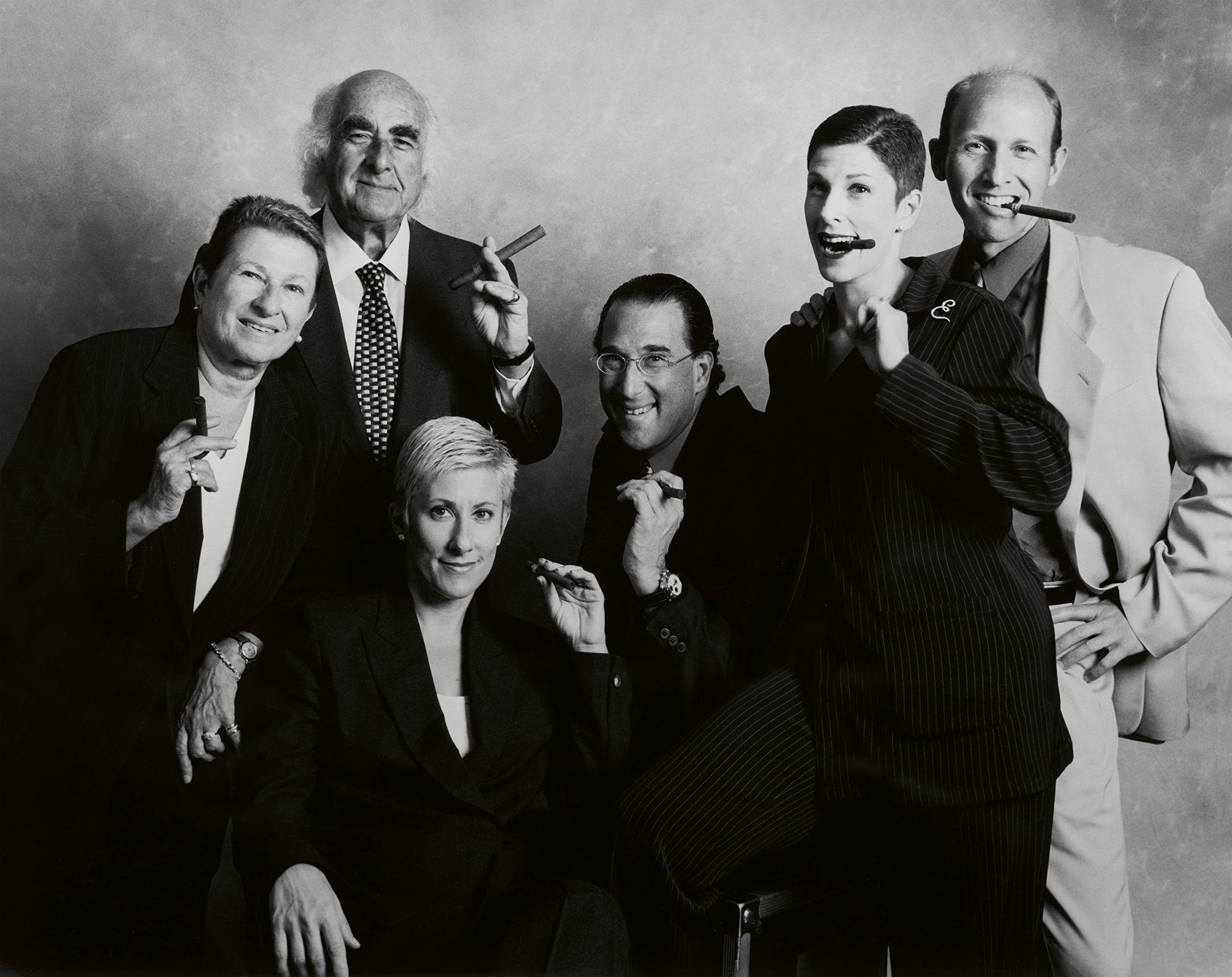
His instinct told him that everyone stood to gain from an honest community that was too secretive in the eyes of the public. He called the media and opened the club’s doors to the press, giving them the key to understanding the industry.
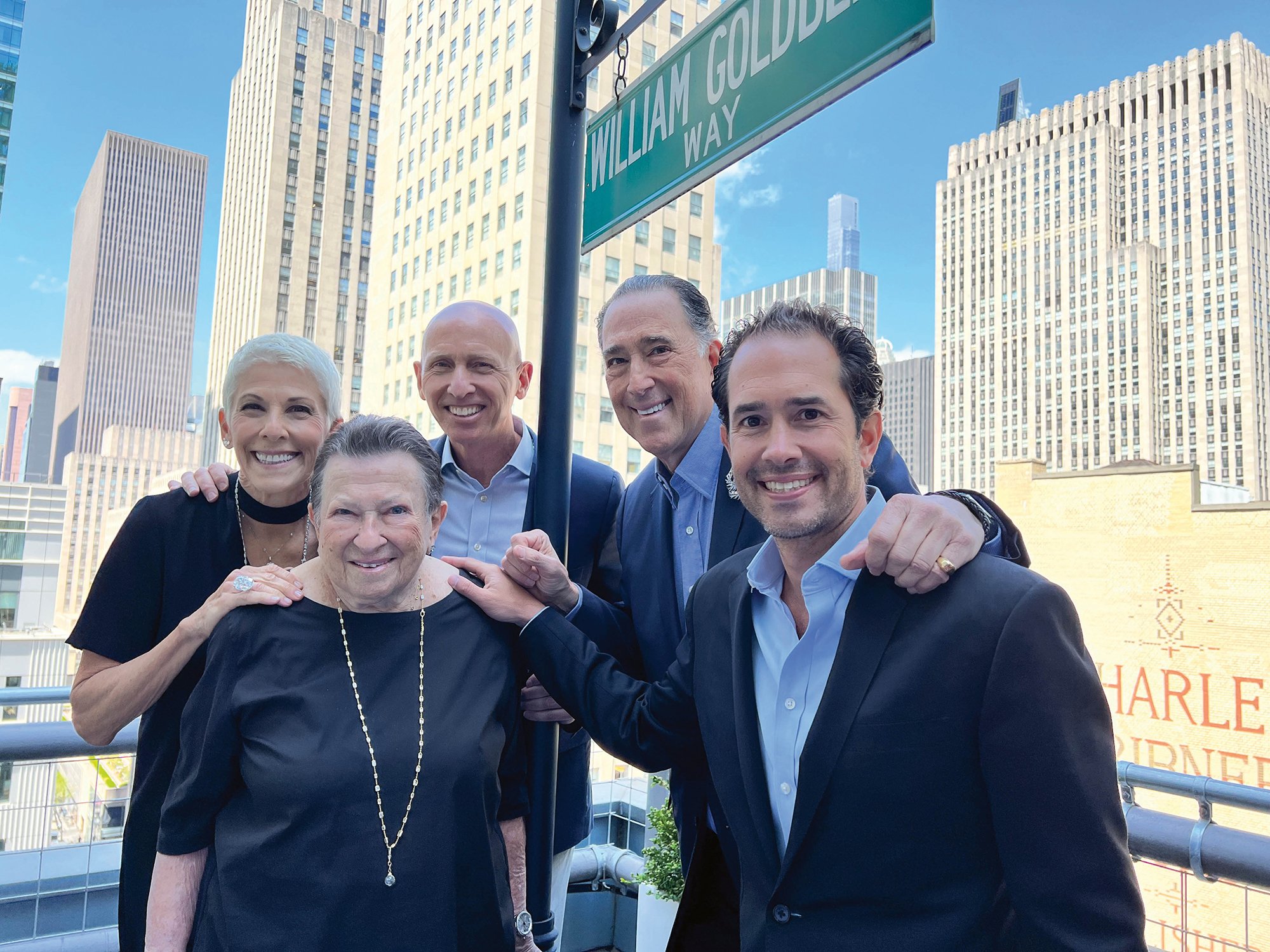
In 2006 Senator Chuck Schumer renamed the junction of 48th Street and Fifth Avenue ‘William Goldberg Way’ in recognition of his role in enabling the industry to flourish in this part of New York. Some would consider it a tribute to his own way of thinking: the William Goldberg way that marked the lives of thousands of diamond cutters and dealers.
In conversation with Eve and Saul Goldberg
Eve Goldberg, his daughter and principle in the company alongside her brother Saul Goldberg, who took the family business from loose diamonds to fine jewellery, brother-in-law Barry Berg and grandson Ben Goldberg, introduce us to this sumptuous book, written by Jill Newman and Jackie Caradonio and published by teNeues. Its 181 pages contain anecdotes, photographs of jewellery, family recollections, quotes from friends, archive photos and extracts from his wife Lili’s notebooks and from his son Saul’s diary when procuring one of the world’s most historic diamonds, the Queen of Holland. These behind-the-scenes glimpses provide fascinating insight into the diamond dealing business as it was in the early 1980s.
Europa Star Jewellery: Could you tell us the story behind the book?
Eve Goldberg: Our family has always wanted to write a book about our father, but it never felt like the right time. Last year, however, marked both the 25th anniversary of the Ashoka diamond and the 75th anniversary of the company founded by my father. It was the perfect opportunity to finally do it. I keep all of the family archives. Whenever one of my siblings finds something that belonged to our father, they give it to me. History is very important to me. I simply cannot throw away anything bearing his mark, such as a piece of paper with his handwriting on it. It’s part of our history. I have a large filing cabinet in my office where I keep all his belongings, such as his passports and price lists from the 1960s. I also have his books containing all his accounts from the 1960s and 1970s. I have records of every country he ever visited. I opened the cabinet to [authors] Jill and Jackie, inviting them to work with me to finally write something that would be more than just a beautiful jewellery book, but a real tribute to our father. We have such a story to tell.

What is your earliest memory of your father trading iconic diamonds?
Saul Goldberg: The most famous would be the Premier Rose, because that was the stone that launched him into the world of very large diamonds. All his life he had traded standard diamonds – one-carat, two-carat and three-carat stones. But the Premier Rose was in a league of its own. It was a 353.9-carat rough stone that he bought from our partners in Africa. People were wondering what he would do with such a stone. In the end, he produced the largest [137.02 carats] pear-shaped D Flawless diamond graded by the GIA, naming it after one of the cutters in Africa, Rose. The Premier Rose really put him on the map. He named the Blue Lili, another incredible stone, after my mother. The colour of the rough diamond was completely unusual but wasn’t appreciated at the time. My father decided to sacrifice three quarters of its weight [100 carats] to create a stunning 30.06-carat Fancy Intense Blue diamond. It was worth around four or five million dollars, but nobody was really excited. People weren’t focused on coloured gemstones at that time, even though the colour of this diamond was like a sapphire blue. Today, it would be worth much more.

What about the Pumpkin?
Saul Goldberg: Our buyer in South Africa bought the Pumpkin without realising that the stone concealed such a colour. It was yellow, with a brownish surface, but after we cut it and the skin came off, it became a fabulous Fancy Vivid Orange 5.54-carat cushion cut. We sold it at Sotheby’s on Halloween Eve 1997 to Harry Winston, Inc. for $1.3 million. Winston named it “Pumpkin” because of its orange colour.

Your father was renowned for being larger than life. Was he really the kind of man people could never forget?
Eve Goldberg: Everyone who met him had a great story about him. He was extremely charismatic. Even today, some people still call or write to me to share stories that I’d never heard before. This just goes to show what an impact he had on people’s lives. He was a brilliant, compassionate man who loved people and loved talking to them. He helped everyone. Many people in our industry approached him for advice. He would give them his time, offer advice and lend a helping hand.
Would you say that the man he was at home, as a husband and father, was the same man he was with everyone else?
Eve Goldberg: He was pretty much the same. He was very genuine. He didn’t do bullshit. Forty years ago, he wasn’t afraid to talk to people about being in psychotherapy. It was not a subject that people dared to talk about at that time, but my father would talk about it with pride and honesty. He was an open book. He didn’t have much of a filter, so he was the same with us as he was with other people — except he was much tougher on us.

Why do you think he was tougher on you?
Eve Goldberg: He was kind and generous, but he was tough when he was teaching us the ropes of the business. He wanted us to be better than everyone else. Working with him wasn’t easy. Nevertheless, thanks to him, I learned more than I think I could have learned at any school in the world. He really was a great educator. He once told us that he would rather be remembered as a great teacher than a great father.
If you had to sum up your father in a few words, what would they be?
Eve Goldberg: First of all, he was passionate. Passion was his watchword. He would tell anyone who wasn’t passionate about their work, ‘Don’t do it. If you go to work and you’re not passionate about it, you’re in the wrong field.’ He was intense, loving, generous, curious and fascinating. You could talk to him for hours about anything and everything. He was always eager to hear about other people and constantly looking to learn. He asked lots of questions. For example, he never hesitated to question rabbis about the existence of God.

Could this be linked to his childhood?
Eve Goldberg: He grew up in the harsh world of those children whose parents are both business owners, shopkeepers. They owned a candy shop and he did not spend much time with them because they were always working. His mother was more of a businesswoman than a motherly figure and was renowned in the neighbourhood for being strict. She wouldn’t give the kids sweets for free. My father started working at a young age, too. Everything he learned were life lessons. That’s also how he taught us. He loved learning, but he preferred to learn from people rather than from books. Nevertheless, he read newspapers and magazines to the point that my mother would go crazy — we had piles of them in the apartment, including previous weeks’ copies of The New York Times which he hadn’t read, but kept because he wanted to catch up on them. He would always come in with articles to educate us. He never missed an opportunity to do so. Although he wasn’t the most well-read person, he could analyse any situation and come up with a solution. This applied to everyone, from our family to the diamond cutters who worked with us. Ultimately, people appreciated him for his wisdom.
What was everyday life like with a father like him?
Saul Goldberg: At home, we would sit around the dinner table and discuss the TV shows we had watched that week. He would literally sit at the table with his eyes closed. You would think he was falling asleep while we talked, but he would suddenly become fed up with listening to us, say something profound and start a new conversation. He never wanted us to waste our time on nonsense. He wanted us to engage with more meaningful topics. He wanted us to talk about more important things in life than TV shows. His understanding of the mind and of human beings was remarkable.
Your father grew up surrounded by sweets and you all grew up surrounded by gemstones. What was that like?
Saul Goldberg: He worked a lot when we were young. He was always travelling. He was always in Antwerp, Belgium, and all over the world to make money. He was building the business. To be honest, he didn’t bring many diamonds home. He worked very hard and was tired when he came home, so he preferred to talk about family and the community. My friends used to tell me, ‘You don’t have to go to university; you’re going to go into diamonds anyway,’ but I wasn’t sure. My father never made it clear that I was following in his footsteps — but that’s what happened.
What about your own children? What’s their relationship with diamonds and the business?
Saul Goldberg: My son Benjamin Goldberg is in the business. Benjamin is incredible. He’s been in the business for 12 years now and he’s passionate about it. He loves diamonds and travels the world. He’s doing everything his father and grandfather did: he buys, he sells. In the early days, I told him to go into property and try a different line of work, and I pushed him away. After three or four years, he came to me and said, ‘Why are you pushing me away? If my grandfather loved the business and you and I love the business, why shouldn’t I join and carry on?’ So here he is.
And does he have a new vision for the business?
Saul Goldberg: To be honest, Benjamin is a bit old-school in the sense that relationships are the most important thing to him. We don’t have a lot of customers, but those people are a real asset. Benjamin would say it’s all about these great relationships.

We haven’t spoken about your mother, Lili, yet, but she played an important role in the Goldberg company. The book is also a homage to her.
Eve Goldberg: This year is her 96th birthday. She is still in good health. During their marriage, she and my father travelled all around the world. She accompanied him on every trip. In the book, you will find photos of all her little notebooks in which she recorded every trip they took. She wrote down everything they did, who they had lunch with and their daily routine. Our mother chronicled their life and travels together. She truly was the woman behind the man. She was with him through everything. She worked in the office for many years and kept him on the right track, no matter what. She was the peacekeeper between him and us, too. She is an amazing woman.
Saul Goldberg: Our mother is a very simple person. She doesn’t care much for jewellery. Give my mother a large stone and she’ll say ‘It’s too big. I don’t want it. I don’t wear big diamonds.’
The book focuses on your father’s legacy, too.
Eve Goldberg: He undoubtedly transformed the industry in New York and worldwide. He was a true visionary who embraced change. Whereas some people dislike change, especially in our industry, he was the absolute opposite. He was always looking for ways the industry could do better and never hesitated to appear on TV shows to promote the diamond industry.

Is it fair to say that your father had the same instinct with diamonds as he had with people?
Eve Goldberg: Indeed. He used to say that ‘you should never cheat a diamond of its right to be beautiful.’ This belief changed the diamond business, as he considered that diamonds should be cut to maximise their brilliance, regardless of their weight. There were narrow limits in the diamond business. Weight was considered the most important factor. My father changed that. He brought a more vivid vision of what a diamond should be. For him, a diamond had to be tailored, cut to be as beautiful as possible, whatever the cost. It was a lesson in how to make a powerful statement with a diamond that was smaller than another. What mattered most to him was the instinctive dialogue between the diamond and the client. He used to say that a diamond should speak to a person in such a way that she would feel as though it were meant for her.
You share the same concept, don’t you?
Eve Goldberg: We all have that idea here. When someone comes to me for help with choosing a diamond, I always tell them ‘Don’t ask me. You have to choose the one that will make you say, that’s my diamond!’ A diamond should talk to you. That’s also how my father changed the business. He stretched the limit of belief about the real value of a diamond rather than focusing on certificates or the GIA. ‘Look at the stone’ he would say. ’You’ve got to look at the diamond and see how it speaks to you.’ People are on the wrong path when they start comparing GIA certificates. You cannot look at a certificate to decide which diamond is more beautiful. You have to look at the diamond itself.

Your father said that jewellery is meant to be worn. This may seem obvious, but it was revolutionary in its own way.
Eve Goldberg: My father didn’t just change a world where certificates were the only thing that mattered. He believed a diamond should never be left in a vault. That drove him crazy. He used to tell customers to wear their jewels, not cage them. ’Why get them if you don’t wear them?’ he would say. ‘You have to wear them, you know? It’s a pity to just leave them sitting in the vault.’ He knew people were afraid to wear their diamonds. They prefer to save them for special occasions but he tried to tell them that jewellery should be worn every day, like makeup. Personally, I can leave the house without makeup but never without a pair of earrings, no matter what. I feel naked without them. Jewellery shouldn’t just be there to be admired or stored away in a box. I love it when women buy things for themselves. I think it makes them feel even better knowing that they were able to afford it. It’s a great feeling of pride.
He also believed strongly that diamonds should bring joy to people’s lives.
Eve Goldberg: As my father always said, we’re fortunate to be in a business that puts a smile on people’s faces. Diamonds are always given for happy occasions, never sad ones. So we bring joy to people’s lives every day.
The William Goldberg Way , Eve Goldberg, Jackie Caradonio and Jill Newman, teNeues, 2026


