



entacles outstretched, the octopus looks for all the world to be floating beneath the sapphire crystal, drifting through a sea of tiny glass bubbles. Viewed through a loupe, its eyes, its suckers, every infinitely small detail is revealed — details one would have imagined impossible to achieve on such a small surface. How did master glass artist Simone Crestani succeed in containing such a delicate sculpture in the few centimetres of a watch dial?
One of the pieces in Vacheron Constantin’s Métiers d’Art Tribute to the Animal Kingdom, his Glassoctopus gives the measure of the “One of Not Many Crafts Programme”, which calls on non-traditional horological métiers d’art and observes how far an artisan can push their discipline when confronted with a previously unexplored scale.
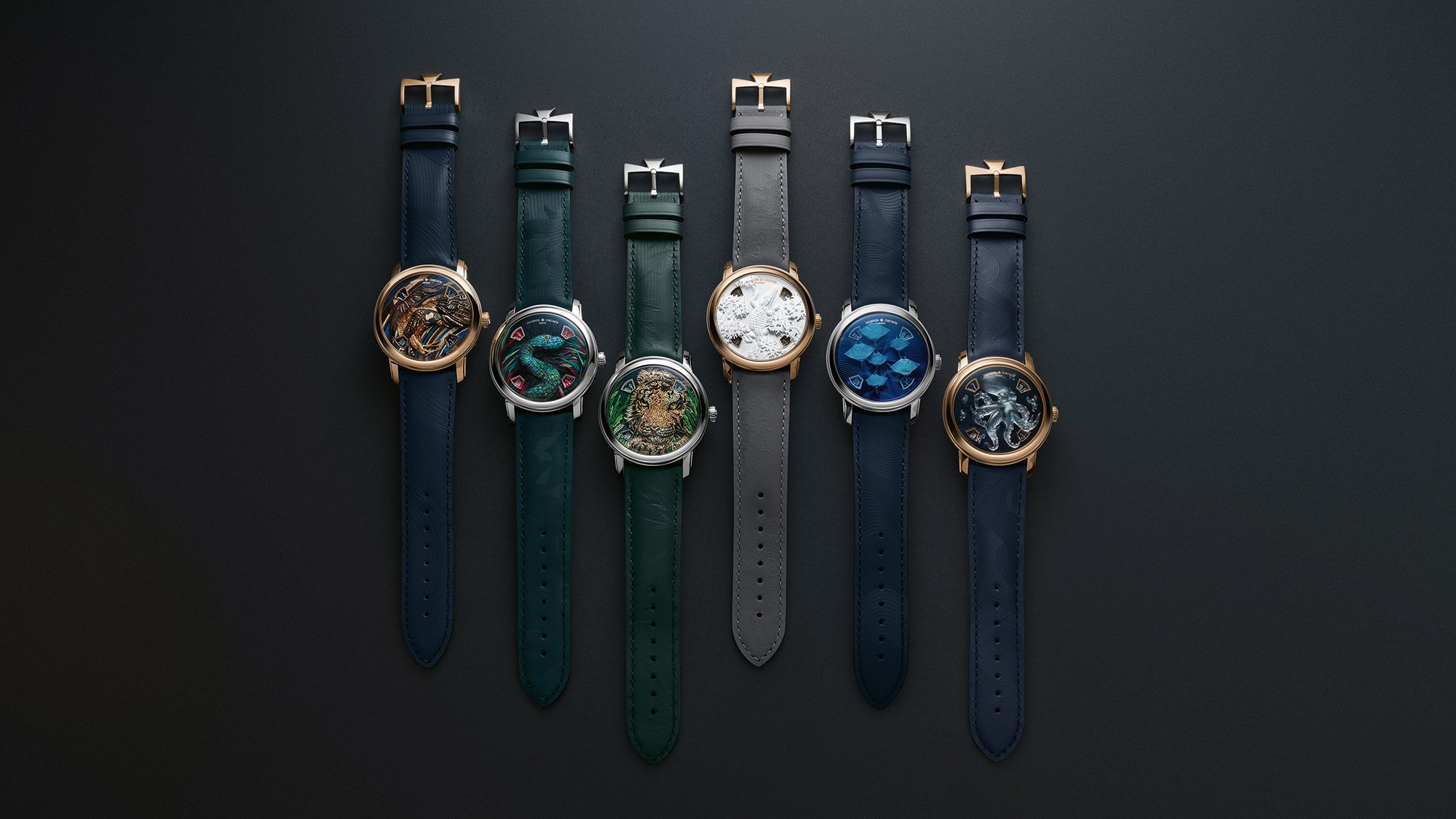
Six artisans, six crafts and six concept watches that were more than two years in the making. These unique pieces will not be offered for sale but conserved by the Manufacture in its patrimony. They should be considered less the foundation for a new collection and more a laboratory of artistic experimentation.
“We set out into the unknown,” explains Christian Selmoni, Vacheron Constantin Legacy and Style Director. “We began with absolutely no idea as to whether or not we would succeed in transcribing these crafts into a watch to the highest standard. Now, when we see the result, we just want to keep going.”
Innovation in watchmaking’s métiers d’art
The métiers d’art have been present at Vacheron Constantin since the late eighteenth-early nineteenth century. “Historically, the four disciplines of enamelling, guilloché, gem-setting and engraving are integral to the Manufacture,” says Selmoni. “They were brought in-house in the mid-2000s, following which collaborations with outside artisans and artists have steadily expanded the vocabulary of decorative arts we apply to our watchmaking.”
The “One of Not Many Crafts Programme” takes a different approach that goes beyond exploring new expressions of established horological crafts. Instead, it seeks out disciplines that are habitually practiced on a much greater scale and tries to transpose them to a watch.
The Homo Faber exhibition was a catalyst, with five of the six artisans having presented their work there: feather artist Julien Vermeulen, glass artist Simone Crestani, embroidery artist Laura Baverstock, paper sculptor Marianne Guély and marquetry-maker Anna Le Corno. The sixth, micro-origami artist Anja Midori, was discovered by Vacheron Constantin’s Innovation department.
All six were invited to Vacheron Constantin in Plan-les-Ouates, where they were immersed in what was, for some, a completely unfamiliar world. They explored the Manufacture then visited Watches and Wonders before embarking on their first trial pieces. “The idea was for us, and them, to see the extent to which they could miniaturise their work,” says the in-house designer who served as the creative interface with the artisans.

A subject dictated by technique
She continues: “We already had an animal theme in mind but had still to decide which six animals they would be. They had to bring out the qualities of the medium and the technique while respecting the artisans’ language. We worked with the artisans to choose animals that lent themselves to their discipline.”
Christian Selmoni insists on the collaborative nature of the project, which grew out of a dialogue between the six artisans, the Innovation Team and the in-house designer: “We’re a long way from the usual procedure, when we provide an artist or an artisan with a finished design which we ask them to interpret. Here, we took a completely different approach. We accompanied the artisans, encouraged them, but also tested them so they could enter our world.” A method Selmoni defines as co-creation.
Challenge accepted
The encounter with Simone Crestani is in many ways representative of the programme. Vacheron Constantin had discovered the Italian master glass artist at an edition of Homo Faber, where he presented an ornate Venetian-style goblet whose decoration of tiny bees caught the Manufacture’s eye.
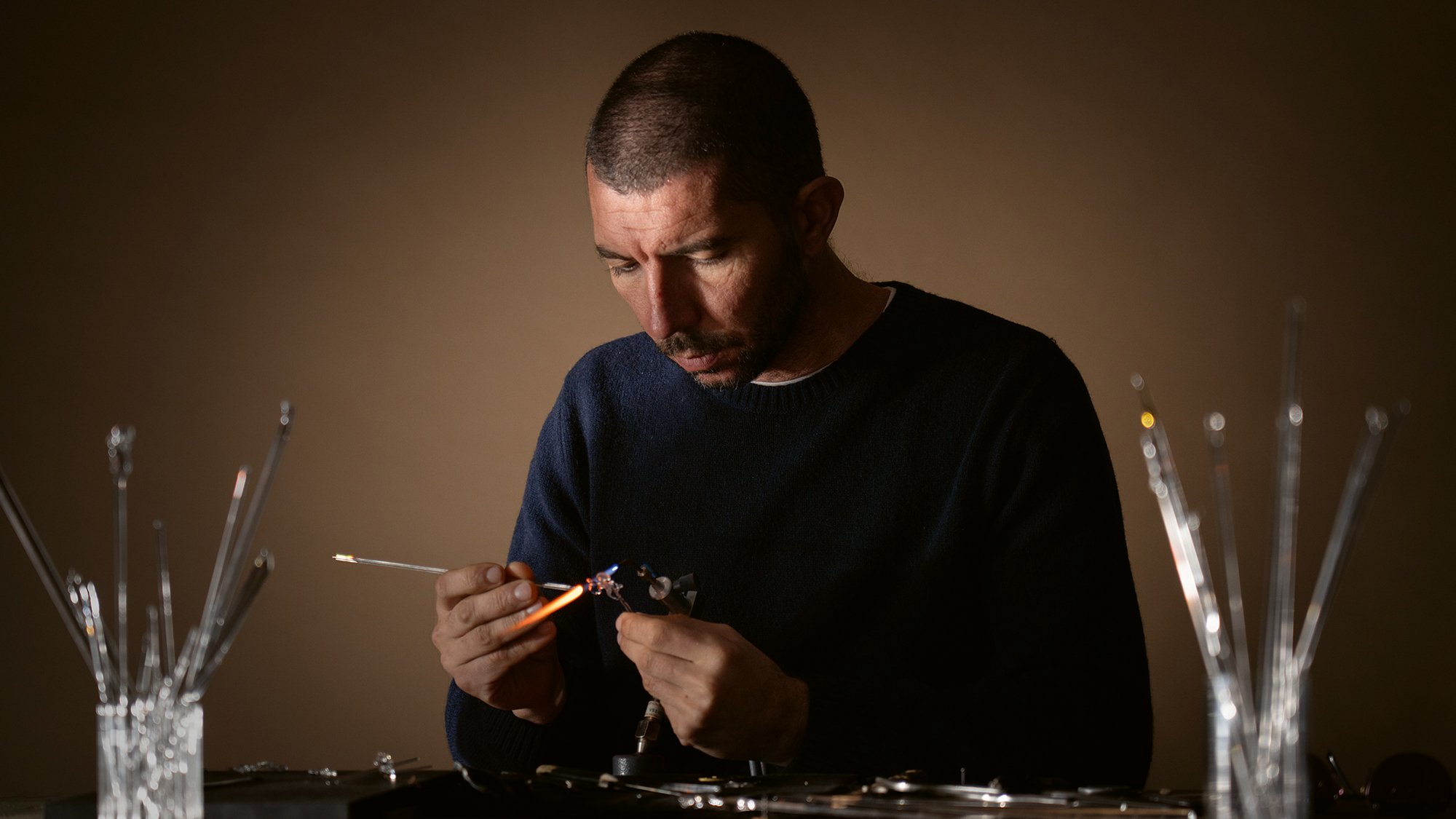
While Crestani often incorporates insects and small details into his large sculptures, he had never previously worked on the microscopic scale of a watch dial, so when Vacheron Constantin suggested the experience, his initial reaction was one of perplexed enthusiasm. “This was certainly an interesting proposal but I wasn’t sure how I would go about it,” he confides. “At this very small scale, glass becomes difficult to control. It was an ambitious project but I enjoy a challenge so I didn’t think twice about saying yes.”
A miniature glass octopus
The question then was which animal would he create? Artist and designer talked through the various possibilities and agreed that the transparency and fluidity of glass lent itself to the octopus’s movements. Simone Crestani had made octopuses in the past, several even, but never this small.
On a conventional scale, Crestani works with a mass of molten glass which he stretches and models into shape. However, the techniques he had mastered for decades failed him when it came to making the thread-like tentacles that would fit the confines of a dial. The challenge came from glass’s physical properties, as he explains: “When heated to working temperature, glass becomes liquid and is subject to surface tension. Like a water droplet that naturally takes a rounded form, a very thin glass filament, when reheated, will also try to take a spherical shape. The same property exists in a large piece of glass but at such a small scale, the effect is amplified.”

The initial trials left him in no doubt: he couldn’t make this octopus using the same techniques as before. “At first I tried the usual way but at that scale, it simply didn’t work. The challenge then was to devise an alternative method.”
Build rather than shape
The solution was to tackle the problem almost in reverse. Rather than begin with a mass of glass which he heats, stretches and shapes, Simone Crestani made his octopus through successive additions of material. “You could compare the process to 3D printing,” he says. “Instead of heating the glass then pulling it into shape, I built it dot by dot.” One thread of glass was added to another, the two fused together, and the process repeated to gradually give form to the octopus: “This was the only way I could control the exact position and dimensions of the tentacles.”
Crestani then had to create the finer details. For a large piece, the artist would heat the glass then sculpt it with tools. However, reheating the glass in this instance would have destroyed the miniature octopus he had so patiently constructed. The solution came from specially developed tungsten tools. The metal, not the glass, was heated to a high temperature and the tools used to impress details at precise points without having to reheat the entire piece.

Using this method, Crestani made each individual sucker, first placing a tiny dot of glass then hollowing its centre with the hot tungsten tool. Without this technique, “the whole thing would have melted and the sucker would have disappeared.” He applied the same principle for the octopus’s eyes. Surprisingly, the tiny bubbles that surround the octopus proved less complex as surface tension went from foe to friend, causing the glass to form a sphere.
Different scale, different gestures
“When I look at these six watches, I’m struck by the exploit each of these artisans has achieved,” says Christian Selmoni. “They came out of their comfort zone to rethink their art on the smallest of scales. Some decorative crafts, when miniaturised, inevitably come up against physical limits or the limits of the technique. These six watches are united by excellence.”
In Christian Selmoni’s words, for the six artisans the project “was truly an adventure.” For some, this was their first time working through a binocular magnifier. Not only did each artisan bring their skills to bear on the watch; each took something from the project, too, as the experience feeds back into their practice. Simone Crestani admits he no longer sees his craft in quite the same way: “Working on the watch has introduced me to a micro-world and shown that it is possible to create something very, very small and very, very detailed. I’d never really explored this in my work until now.” This experience is already finding its way into his other creations. The bees he incorporates into certain sculptures are now smaller and more detailed than prior to his collaboration with Vacheron Constantin.

A celebration of craftsmanship
The six watches remain concept watches. They have not completed the necessary qualification, certification and homologation procedures required for commercial production. “This programme is an incubator for ideas,” says Christian Selmoni. “We can use it to expand the range of our métiers d’art and potentially introduce new ones. Looking at these concept watches, you realise how much creative emulation a programme such as this can set in motion. For us, too, it has opened new horizons.”


